How Multi-Building Corporate Campuses Are Managed by a Single Drone Operations Center

A single corporate building is a manageable security problem. It has a defined perimeter, a limited number of entry and exit points, and a floor plan that a guard can learn in a week. Camera coverage is designed around a known layout. Access control logs every door. The patrol route is short enough to complete in a reasonable interval.
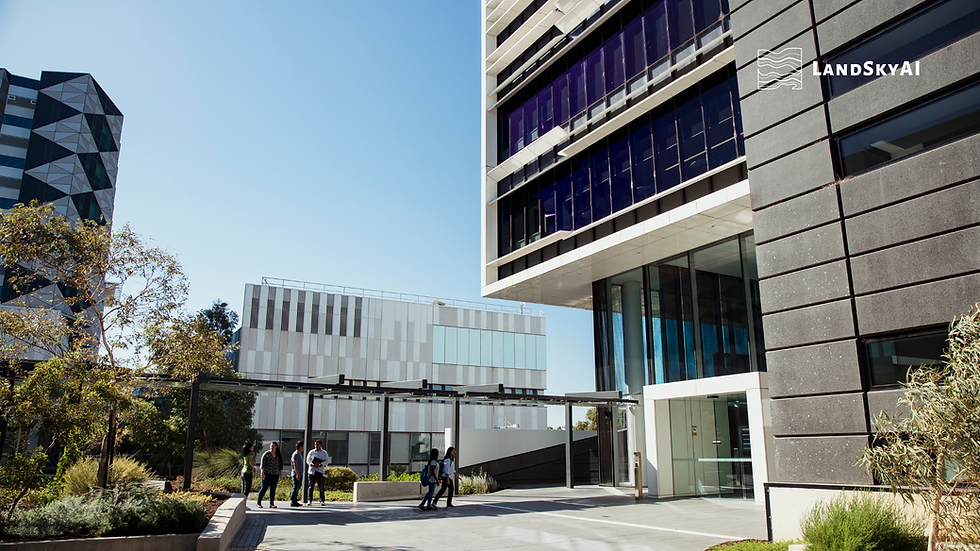
Add a second building 300 yards away, connected by an outdoor walkway, with its own loading dock, parking structure, and set of access points. Add a third and a fourth, spread across a campus that spans 50 to 100 acres with outdoor plazas, equipment yards, and service corridors between them. Add underground parking connecting two of the buildings and a separate facility at the rear of the property that houses IT infrastructure.
That's not a single security problem anymore. That's a coordination problem.
Corporate campuses with multiple buildings present a security challenge that distributed guard programs handle poorly and that the security industry has never fully solved with conventional technology. The issue isn't whether any individual zone can be monitored. It's whether the zones can be monitored simultaneously, coordinated in real time, and managed from a unified operational picture. A single drone operations center is how that problem is now being solved.
The Multi-Building Corporate Campus Coordination Problem
The fundamental challenge with corporate campuses that span multiple buildings is that no ground-level vantage point can see all of them at once.
A guard at Building A's entrance cannot see Building D's loading dock. A patrol circuit that covers the south parking structure cannot simultaneously observe the equipment yard behind Building B. Fixed cameras cover the areas they were designed to cover; the corridors, angles, and approach zones between buildings are where coverage thins. As campus footprints grow and the number of structures increases, the coverage geometry becomes progressively harder to solve with ground-level resources.
Standard corporate security staffing guidance calls for one guard per 50,000 to 100,000 square feet, depending on facility layout, risk level, and visibility across the property. A corporate campus with ten buildings totaling 800,000 square feet of indoor space, plus significant outdoor areas, requires eight to sixteen guards to meet that standard at any given time. That's eight to sixteen guards who need to coordinate by radio, divide coverage zones across a campus that has no single perimeter, and manage handoffs between buildings, shifts, and patrol areas in real time.
The coordination overhead is significant. A campus security director managing that program is not running a unified security operation. They're running a distributed one, where coverage depends on each guard knowing their zone, maintaining their patrol schedule, and communicating effectively with the rest of the team across a property large enough that radio calls can be the primary situational awareness mechanism.
Multi-building campuses built across different construction eras compound this further. A campus that added buildings over 30 years of growth typically has different door hardware, different camera systems, and different access control infrastructure in each building, each representing a different vintage of security technology that doesn't always integrate cleanly with the others. A security director trying to pull a unified picture of campus-wide activity from eight separate building management systems is not getting a unified picture. They're getting eight separate pictures.
Why Distributed Guard Programs Struggle at Campus Scale
The coverage problem in a multi-building corporate campus program is structural, not a function of guard performance.
Seventy-seven percent of the security services industry turned over its workforce in 2024, according to ASIS International research. Some contract security providers report turnover rates as high as 300%. On a multi-building corporate campus with a 15-guard program, that means replacing 11 or 12 guards over the course of a year. Each departure resets institutional knowledge about a specific building, a specific patrol zone, or a specific coordination protocol. The guard who knew that the northeast service corridor is a persistent problem area has left. The new guard learns it through experience, not briefing.
The coverage gap during onboarding periods is the part of the turnover cost that rarely appears in budget models. A guard in their third week on a multi-building campus doesn't know the layout the way a guard in their third year does. They don't know which outdoor corridor is poorly lit enough to be a persistent problem, which parking structure access point gets used as an informal passage after hours, or which building's loading dock alarm has a 30-second false trigger delay. That knowledge is institutional, accumulated through patrol experience, and it resets with every departure.
The coordination problem intensifies as incidents develop. When an alarm fires in a specific building on a large corporate campus, the guard program's response begins with a question: which guard covers that area, and where are they right now? The answer requires radio contact, position confirmation, route to the alarm location, and arrival time estimation, all before anyone has eyes on the situation. On a sprawling campus where a guard might be several hundred meters away from an alarm trigger, that sequence takes time that matters in an incident.
The FBI designated 34 active shooter incidents in the United States in 2025, a 42% increase from 24 in 2024. Commerce locations, including corporate offices and business premises, represent one of the five incident categories the FBI tracks. The predatory nature of planned incidents means that campus security posture, specifically how visible and rapid the response appears to be, is part of what determines whether a planned incident proceeds. A campus where response coordination is slow because it depends on radio calls across a distributed guard program presents a different threat calculus than one where an aerial platform is overhead and verified within 90 seconds.

How a Single Drone Operations Center Manages Corporate Campuses
A drone operations center managing a multi-building corporate campus addresses the coordination problem by replacing sequential, ground-level coverage with simultaneous aerial oversight across the full campus footprint.
The operational model works because of altitude. A drone at 80 to 100 meters above a corporate campus has line of sight to every building, every outdoor corridor, every parking structure approach, and every service area simultaneously. The single aerial platform covers the coverage geometry that eight separate building camera systems, covering their individual fields of view from fixed angles, can't replicate from the ground.
When an alarm trigger fires in Building C's loading dock at 11:30 PM, the drone operations center responds in a sequence that is faster and more informationally complete than a distributed guard program. The alarm integration sends an automatic launch signal. The drone is airborne within seconds, reaching the loading dock area in under 90 seconds. The operator in the remote operations center has live aerial video before the nearest ground response has crossed half the campus distance. By the time the responding guard arrives, the operations center can tell them whether there is a person at the loading dock, where they are, whether they're moving toward the building or away from it, and whether they appear to be alone.
That pre-arrival intelligence changes the nature of the ground response. The guard isn't approaching an unknown situation in the dark. They're responding to a briefed situation, with aerial eyes still overhead.
The operational picture across the full campus is the other dimension. A drone operations center managing a multi-building campus has a unified view of all activity across all buildings simultaneously, not a fragmented picture assembled from radio reports and individual building camera feeds. When two separate sensor events occur at opposite ends of the campus within minutes of each other, the operations center identifies them as separate events, tasks responses to each, and determines whether they're related, all without the coordination delay that a distributed guard program requires to process two simultaneous calls.
What Integration Across Multiple Buildings Looks Like in Practice
The operational effectiveness of a single drone operations center across corporate campuses depends on integration with each building's existing alarm and sensor infrastructure.
Every alarm trigger across all campus buildings feeds into the same operations center. A motion sensor on the Building D equipment yard, a door contact on Building B's service entrance, a perimeter beam on the northwest fence line: all of them route to the same monitoring infrastructure that dispatches the aerial response. The operations center doesn't need to know which building's guard is responsible for which zone. It dispatches the drone to the location, verifies the situation, and coordinates the ground response based on what the aerial feed confirms.
The six-service operational ecosystem behind a managed drone program, including site survey, patrol planning, remote piloting, preventative maintenance, and analytics, is what makes that integration operational rather than theoretical. Site survey maps every building's alarm infrastructure and identifies the coverage zones where aerial response adds the most value over fixed cameras. Patrol planning programs flight routes that cover all buildings on a rotating schedule calibrated to the campus's risk profile. Remote piloting provides the FAA-authorized operators who fly each mission. Analytics produce the unified reporting that shows campus-wide coverage hours, incident response times, and detection records across all buildings in a single output.
For a corporate security director presenting program performance to leadership, that unified reporting changes the conversation. Instead of aggregating fragmented patrol logs from eight buildings, they're presenting a single operational dashboard: total coverage hours across all campus buildings, response time from alarm trigger to aerial verification, incident documentation with timestamped video from all events. The management picture is coherent because the operation that produced it is centralized.
The Economics of Centralizing Corporate Campus Security
The staffing math for a multi-building corporate campus resolves differently when a drone operations center replaces some of the distributed guard function.
Industry guidance calling for one guard per 50,000 to 100,000 square feet is written for a model where guards are the primary coverage mechanism. When an aerial operations center provides continuous campus-wide situational awareness, the guard program's function shifts from coverage to response and access control. The number of guards required to respond to verified incidents and manage access points is substantially lower than the number required to provide patrol coverage across an entire multi-building footprint.
The reduction in patrol staffing and the corresponding reduction in the turnover cycle that comes with it represents a meaningful cost change. A corporate campus that reduces its patrol-focused guard count by four or five positions to fund a managed drone program is eliminating four or five annual turnover cycles, the recruiting cost, the onboarding cost, the reduced-effectiveness period, and the institutional knowledge reset that each departure produces. The operational program runs more consistently because its continuity doesn't depend on the local guard labor market filling positions.
LandSkyAI's VirtualGuard program deploys and manages autonomous drone and robotic security across multi-building corporate campuses, integrating with existing building alarm systems, running continuous patrol coverage across the full campus footprint, and providing 24/7 remote monitoring from a single operations infrastructure. The patrol, the response, the coordination, and the reporting all run from one managed program rather than a distributed guard network coordinated by radio.
If your campus security program is managing 8 or more buildings across a large footprint and your security director is spending significant time coordinating coverage across zones rather than managing outcomes, we can show you what unified aerial operations look like on your specific campus layout.
Schedule a corporate campus security assessment.
What's the hardest coordination challenge in your multi-building campus security program?
Real-time visibility across all campus buildings
Faster alarm response across distributed building zones
Unified security reporting across all buildings

Did you find this article useful? Are you interested in seeing us in action?
MissionControl is LandSkyAI’s ongoing town hall style webinar where you can get to know who we are, what we do, and how we’ve built our autonomous security programs. We also conduct a fully live remote drone demo, every time!
Our next event is on Wednesday, September 30th, 2026
Thank you for reading SkyBlog! Found it interesting? Hit that link 🔗 button and send to a friend! If you have questions or want to explore how these solutions apply to your environment, contact the LandSkyAI team below to start a conversation. ✌️