LandSkyAI at GSX 2026: Booth 3007 and the Full Capabilities of a Managed Drone Security Service
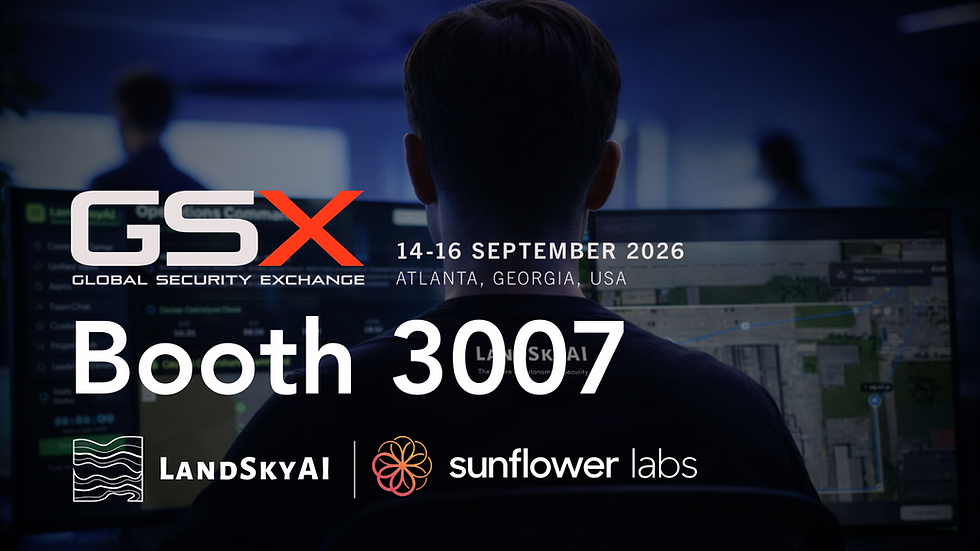
GSX 2026 opened yesterday at the Georgia World Congress Center in Atlanta. If you're here today, we're at booth 3007.
That's the short version. The longer version is what we've been building toward, and what we're showing on the floor: a fully managed drone and robotic security service that covers every part of the deployment that hardware vendors don't.
The security industry has spent the last several years evaluating autonomous drone technology. The equipment has improved significantly. The use cases are well established. The question that security directors keep coming back to isn't whether drones work. It's who operates them, who manages the FAA requirements, who runs them at 2 AM, and who produces the security output that justifies the investment. That's the question a managed drone security service answers. That's what we're here to show.
What "Fully Managed" Actually Means at Booth 3007
The phrase "fully managed" gets used loosely in security technology. At booth 3007, we're defining it specifically.
A managed drone security service means LandSkyAI handles every operational layer between the hardware taking off and the security outcome your program needs. Site survey and mapping. Patrol planning and programming. FAA waiver management and BVLOS authorization. Remote piloting from our VirtualGuard operations center. Preventative maintenance and hardware support. Analytics and incident documentation. All of it.
Your security team manages the outcome: what the coverage looks like, what triggers an alert, what the documentation requirements are, what the report says at the end of each week. The operational infrastructure that produces that outcome runs on our side.
That distinction matters for enterprise security programs because the operational burden of running an autonomous drone program, finding licensed remote pilots, managing FAA compliance, maintaining hardware, integrating with existing alarm systems, and keeping a program running 365 days a year, is what breaks most in-house deployments. A fully managed service removes that burden entirely and replaces it with a security outcome you can evaluate directly.
We've crossed 100,000 BVLOS drone flights delivering that model at real facilities, at major public events, and across complex outdoor environments. The booth is where you can see what the program looks like in practice.
The Four Services We're Showing at GSX 2026
SkyGuard: Autonomous Aerial Drone Patrol
SkyGuard is our drone-in-a-box aerial security service. Autonomous patrols run on programmed routes covering perimeter fencing, outdoor yards, parking areas, access corridors, and any outdoor zone the facility defines as a security priority. When a sensor trigger fires, SkyGuard launches automatically and has aerial eyes on the location in under 90 seconds.
The aerial coverage geometry is what makes SkyGuard different from a fixed camera grid. A drone at altitude has line of sight to the full perimeter footprint simultaneously, without the coverage gaps that ground-level camera installations produce at corners, across terrain features, or in the zones too far from camera infrastructure to cover cost-effectively. SkyGuard covers the outdoor environment that cameras document inadequately and guards patrol intermittently.
The FAA's BVLOS authorization is the operational prerequisite that makes overnight autonomous patrol legally viable. We hold those authorizations. Most operators don't. That's not a marketing point. It's the difference between a program that can operate and one that can't.
LandGuard: Autonomous Ground Robots
LandGuard extends managed security to the ground environments where aerial coverage has limits: parking structures, interior facilities, all-weather perimeter routes, and terrain where drone operation is restricted or impractical.
LandGuard robots run continuous pre-programmed patrol routes across outdoor and semi-enclosed environments, equipped with sirens, strobes, and real-time communication back to the VirtualGuard operations center. They operate in all weather conditions that ground vehicles can handle. They don't call in sick or take a vacation day during the holiday shift when incident rates spike.
The combined SkyGuard and LandGuard deployment is what enterprise facilities with both outdoor and interior coverage requirements look like when the full managed service is in place. Both systems feed into the same VirtualGuard monitoring infrastructure, with human operators reviewing live feeds and managing responses across both aerial and ground platforms simultaneously.
AirGuard: Counter-Drone Detection and Monitoring
The drone threat to critical infrastructure and enterprise facilities has grown in parallel with the commercial drone industry. Unauthorized drone overflights, airspace violations at secure facilities, and the use of small UAS for intelligence gathering on facility operations are documented threats that facility security programs increasingly need to address.
AirGuard provides managed counter-drone detection, geolocation, and airspace monitoring. The service detects unauthorized UAS activity in a facility's airspace, geolocates the source, and alerts operations through the same VirtualGuard infrastructure that manages aerial and ground patrols. Managed counter-drone monitoring is the third security layer for facilities that need to protect not just their ground perimeter but their airspace above it.
VirtualGuard: The Remote Operations Center
VirtualGuard is the human layer behind every flight. Trained operators at our remote operations center monitor live drone and robot feeds throughout every patrol. AI detection flags anomalies. Operators verify every alert before it goes out to the facility's security team. Police dispatch can be coordinated directly from the operations center.
The operator verification step is what distinguishes a managed program from a hardware deployment. AI alone generates false positives at a rate that erodes response discipline over time. A human operator reviewing every detection event and making the dispatch decision is what keeps alert credibility intact. Every alert that leaves VirtualGuard is a verified alert, not a sensor noise event that a guard is going to investigate and find nothing.
The Case Studies Behind the Capabilities
What's on the floor at booth 3007 is backed by field data from programs that have been running in real conditions at real facilities.
The Bank of America Chicago Marathon deployed a LandSkyAI tethered drone for more than 10 continuous hours, from before sunrise through late afternoon. The live aerial feed covered the course, the crowd, and the surrounding environment throughout. During the event, the system flagged an unattended bag, identified individuals in restricted zones, and tracked developing crowd congestion in real time so routes could be adjusted before the congestion required intervention. That's the VirtualGuard model operating in one of the most complex security environments in major event management.
At a high-volume industrial facility in Michigan, the managed program logged more than 7,400 total flights and more than 585 hours of flight time, with alarm triggers answered automatically through drone integration with the site's existing security infrastructure. Aerial verification in under three minutes, every time, without adding headcount to the overnight security team.
In Costa Rica, a managed program at a luxury property logged more than 5,800 flights and more than 800 hours, covering perimeter monitoring, unauthorized watercraft deterrence, construction progress tracking, and solar infrastructure inspection from a single managed aerial platform.
Three different environments, three different security requirements, one managed operational model that adapted to each.

Why GSX 2026 Is the Right Moment to Evaluate This
The regulatory environment for autonomous drone security is changing faster than most enterprise security programs are tracking.
FAA Part 108, the proposed BVLOS rulemaking, is currently under OIRA review as of July 2026. When it finalizes, it creates a certification framework that rewards operators with documented BVLOS track records. Operators who have been running authorized BVLOS programs will be positioned to convert that history into Part 108 Operational Certificates. Operators who haven't started yet will be qualifying from zero.
The practical implication for enterprise security directors evaluating autonomous drone deployment is that the window to start building operational history under the current authorization framework is narrowing. Programs that start now are building the track record that positions the managed service provider for Part 108 compliance when the rule lands.
Beyond the regulatory timing, the economic case for a managed drone security service has become clearer as the data has accumulated. Guard turnover in the security industry ran 77% in 2024, according to ASIS International. Cargo theft at distribution facilities rose 60% in 2025. Physical attacks on electrical infrastructure have been increasing for three consecutive years. The threat environment that enterprise security programs are managing has gotten more complex, and the labor model that most facilities relied on to address it has gotten less reliable.
A fully managed drone security service is the coverage layer that addresses the outdoor environment: the yard, the perimeter, the parking lot, the terrain between buildings, the waterfront, the fence line. The environments where the guard model produces documented coverage gaps and the camera grid produces documented blind spots.
We're at booth 3007 through the close of GSX 2026. Come by to see the full platform, talk through your facility's specific coverage requirements, and schedule an on-site assessment for after the show.
Stop by booth 3007, or reach out to Jake directly at jake@landsky.ai to schedule a facility assessment.
What are you most focused on evaluating at GSX this year?
Autonomous drone patrol and alarm response
Counter-drone detection for your facility
The remote operations and piloting model

Did you find this article useful? Are you interested in seeing us in action?
MissionControl is LandSkyAI’s ongoing town hall style webinar where you can get to know who we are, what we do, and how we’ve built our autonomous security programs. We also conduct a fully live remote drone demo, every time!
Our next event is on Wednesday, September 30th, 2026
Thank you for reading SkyBlog! Found it interesting? Hit that link 🔗 button and send to a friend! If you have questions or want to explore how these solutions apply to your environment, contact the LandSkyAI team below to start a conversation. ✌️